

Future Trends Shaping Reliance Industries
Explore Reliance's path ahead in India & beyond 📈, focusing on growth trends, tech innovations, strategies, and key challenges shaping its future.
Edited By
Amelia Fox
The AUD to USD exchange rate serves as one of the key indicators in global forex markets, directly impacting trade, investment, and economic relations between Australia and the United States. Traders and investors keenly follow this pair because it reflects not only the relative health of the two economies but also broader market sentiments and geopolitical developments.
Exchange rate movements typically arise from a complex mix of factors. For example, differences in interest rates set by the Reserve Bank of Australia (RBA) and the US Federal Reserve influence capital flows, affecting demand for respective currencies. When US interest rates rise, the dollar often strengthens, while higher Australian rates tend to support the AUD.
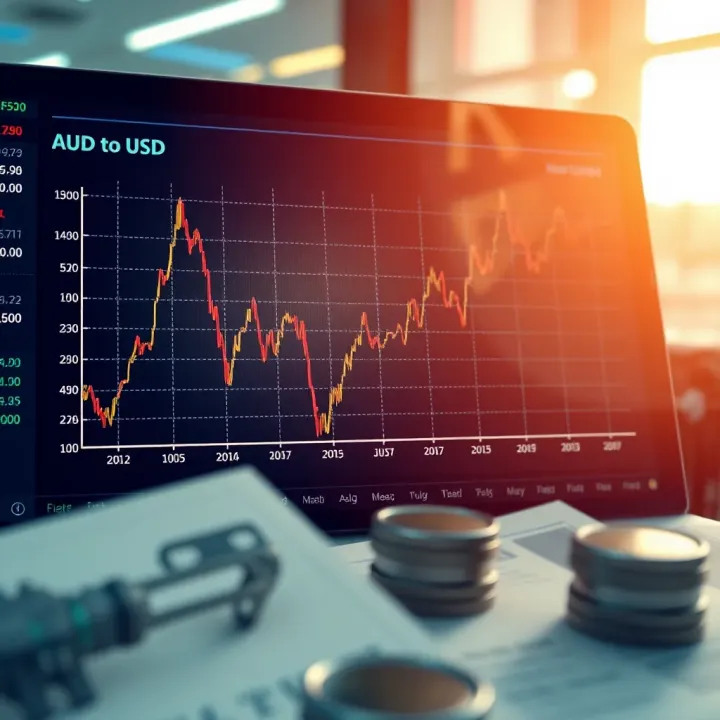
Economic data points such as GDP growth, unemployment rates, and trade balances from both countries also steer the AUD-USD trajectory. To illustrate, strong commodity exports from Australia—like iron ore and coal—can boost the AUD, considering their significant share in Australia’s economy. Conversely, changes in US economic indicators, such as retail sales or manufacturing output, can shift the USD’s value.
Geopolitical events and global risk sentiment heavily shape this pair as well. For instance, rising tensions in the Asia-Pacific region or changes in US trade policy can lead to abrupt shifts. The AUD usually behaves like a risk-sensitive currency, gaining when investors seek higher returns and losing ground during global uncertainty.
In recent years, trends in trade agreements, central bank policies, and commodity prices have driven noticeable swings in AUD to USD rates. Expert predictions often factor in these variables alongside technical analysis to provide forecasts.
Understanding these influences helps traders and businesses make informed decisions, whether for hedging exposure or speculative trading. This section lays the groundwork for deeper exploration of current trends and future expectations for this critical exchange rate.
Interest rate differentials between RBA and the US Federal Reserve
Major economic indicators influencing currency demand
Impact of commodity prices on the Australian Dollar
Global risk appetite and geopolitical developments
Role of expert forecasts in shaping market expectations
This foundational overview ensures readers grasp the essential forces at play before moving into more detailed analysis.
Grasping the AUD to USD exchange rate is essential for anyone dealing with the Australia-US currency pair. Whether you are a trader looking to time your market moves or a business managing import-export costs, understanding how this rate fluctuates helps in making informed financial decisions. The exchange rate not only reflects the relative value of currencies but also embeds various economic signals and market sentiments.
Exchange rates determine how much one currency is worth in terms of another. For example, if the AUD to USD rate is 0.70, one Australian Dollar buys 70 US cents. This rate changes constantly, influenced by supply and demand in the forex market. Knowing the current rate matters because it influences costs, profits, and investment returns for cross-border transactions.
In forex markets, the AUD and USD interact in a highly liquid environment, with both currencies actively traded globally. Factors such as interest rate differentials, economic data releases, and geopolitical events disrupt the balance, leading to currency appreciation or depreciation. For instance, if Australia’s interest rates rise compared to the US, it might attract investors to the AUD, pushing its value up against the USD.
Over recent decades, the AUD to USD rate has experienced notable swings. In the early 2000s, AUD traded near parity with USD at times, thanks to strong commodity prices supporting the Australian economy. However, the global financial crisis and commodity price drops caused sharp declines. Tracking these past trends helps traders and investors anticipate possible future movements by assessing patterns tied to economic cycles.
Major shifts in the AUD to USD rate often tie back to significant economic or political events. For example, the mining boom in Australia around 2005 caused a strong rally in AUD, while the US Federal Reserve’s quantitative easing programmes led to USD weakness. Similarly, trade tensions impact the pair as Australia depends heavily on commodity exports, making its currency sensitive to global demand fluctuations. Recognising these causes sharpens the analysis and supports better forecasting.
Understanding this currency pair involves more than just numbers; it requires connecting economic indicators and global events to market reactions, which is vital for making strategic decisions in trading or business planning.
Economic indicators provide the backbone for understanding fluctuations in the AUD to USD exchange rate. Traders and investors closely watch these factors as they directly influence currency valuation by reflecting the underlying health and prospects of the Australian and US economies. Accurate interpretation of these indicators aids in making informed decisions regarding currency positions and risk management.
The Reserve Bank of Australia (RBA) shapes AUD value through its monetary policies and interest rate decisions. When the RBA raises rates, it tends to attract foreign capital seeking higher returns, pushing the AUD higher against the USD. Conversely, rate cuts or dovish stances generally weaken the AUD. For example, in late 2023, the RBA’s steady approach amid inflation control helped stabilise the currency.
Similarly, decisions by the US Federal Reserve have a global ripple effect. Increases in US interest rates often strengthen the USD, as investors shift funds to benefit from better yields. This can create downward pressure on the AUD to USD pair. The Fed’s communication on policy direction also matters; unexpected signals can trigger sharp moves in the forex markets. Around mid-2023, the Fed’s hawkish tone led to a noticeable USD rally, impacting AUD valuations.

Australia’s economy heavily depends on commodity exports such as iron ore, coal, and natural gas, tying the AUD closely to commodity price trends. A trade surplus driven by robust export prices supports the AUD, signalling strong demand for Australian goods and currency. For instance, a surge in iron ore prices in 2022 buoyed the AUD despite global uncertainties.
Fluctuations in commodity prices, therefore, translate directly into exchange rate movements. When commodity prices fall, the AUD often weakens due to reduced export earnings and deteriorating trade balances. Traders tracking commodity futures alongside forex rates can seize timely opportunities by linking these trends.
Inflation trends in both countries influence central bank responses and currency strength. If Australian inflation edges higher than in the US, it may force the RBA to tighten policy faster, boosting the AUD. Conversely, subdued inflation can delay such moves, keeping the AUD softer. Monitoring Consumer Price Index (CPI) reports from both economies is crucial for anticipating rate adjustments.
Economic growth expectations also shape currency moves. Strong growth signals economic resilience and potential monetary tightening, supporting the currency. Weak growth forecasts may trigger depreciation. For example, slower GDP growth in Australia compared to the US has periodically weighed on the AUD. Analysts often incorporate these growth differentials alongside inflation data to refine their exchange rate projections.
Staying informed about these key economic indicators offers a practical edge for market participants aiming to forecast the AUD to USD exchange rate with better precision.
Understanding external factors and market sentiment is key when analysing the AUD to USD exchange rate. These elements often cause sudden shifts that economic indicators alone cannot explain. Traders and investors who keep an eye on geopolitical events and risk appetite can better anticipate currency fluctuations and manage exposure effectively.
Trade tensions notably impact the AUD to USD rate since Australia heavily depends on global trade, especially with China and the US. For instance, when the US and China imposed tariffs on each other's goods amid their trade war, it affected commodity prices and trade flows, dragging down the Australian dollar against the USD. Currency traders reacted quickly to headlines, causing higher volatility around these episodes. Staying alert to such tensions helps market participants prepare for similar disruptions.
Political stability in Australia and the US also affects their currencies. Investors prefer environments with predictable policies and limited turmoil. For example, political uncertainty in the US during a government shutdown can weaken the USD temporarily, while stable elections in Australia could boost confidence in the AUD. In contrast, unexpected political scandals or leadership changes may reduce investor trust and cause outflows, putting downward pressure on the respective currency.
Global risk sentiment plays a major role in shaping AUD performance. As a commodity-linked currency, the AUD tends to rise when investors seek higher-yielding assets during positive economic periods. For example, when global markets rallied in early 2023, AUD strengthened due to increased demand. However, during times of uncertainty or crisis, such as the COVID-19 outbreak in 2020, risk aversion led to sell-offs in riskier currencies like AUD.
On the other hand, the USD often gains as a safe-haven currency. When fear rises, investors move funds into USD assets like US Treasury bonds, enhancing the dollar’s strength. This was evident during the Russia-Ukraine conflict escalation when the USD rallied while AUD declined. Recognising this dynamic aids traders and investors in timing their positions regarding the AUD to USD pair.
External shocks and shifts in market mood can cause rapid AUD to USD swings beyond what economic data predicts. A close watch on geopolitical developments and risk sentiment remains essential for accurate forecasting and risk management.
Understanding recent trends and the current outlook for the AUD to USD exchange rate is vital for traders, investors, and financial analysts who rely on accurate, up-to-date information to guide their decisions. Currency movement is influenced by a variety of factors, so recognising recent patterns helps in anticipating future shifts and managing associated risks effectively.
Over the past year, the AUD to USD exchange rate has shown significant volatility, reflecting shifts in global economic conditions and domestic policies. For instance, the Australian Dollar weakened against the US Dollar during periods of rising US interest rates, which attracted capital inflows towards USD-denominated assets. Conversely, temporary rebounds occurred when commodity prices, especially iron ore and coal, surged because of supply constraints.
Such fluctuations directly impact traders seeking to capitalise on short-term moves and investors evaluating risk across portfolios. Businesses engaged in import-export operations also watch these changes carefully, as currency swings affect profit margins and pricing strategies.
Several events have shaped AUD-USD movements recently. The Reserve Bank of Australia's (RBA) decisions to modify policy rates in response to inflation pressures altered the AUD's strength. At the same time, the US Federal Reserve's aggressive rate hikes aimed at controlling inflation pushed the USD higher globally.
Additionally, geopolitical tensions, such as supply chain disruptions linked to China-Australia trade relations, contributed to market uncertainty impacting the AUD. Understanding these events is crucial for analysts forecasting trends, as these triggers often lead to short-term shifts with lasting effects.
Market analysts broadly expect the AUD to USD rate to remain sensitive to interest rate differentials between Australia and the US in the near term. Short-term forecasts suggest the possibility of further AUD depreciation if the Federal Reserve continues tightening while the RBA adopts a more cautious stance.
Medium-term views consider potential corrections if commodity prices stabilise or improve, supporting the Australian economy and possibly strengthening the AUD. Forecasting models often incorporate scenarios accounting for economic growth disparities, inflation outlooks, and risk sentiment among global investors.
Experts emphasise the interplay between economic indicators and geopolitical events as key drivers for the AUD-USD exchange rate. Factors like Australia's trade balance, domestic inflation trends, and US monetary policy remain at the forefront of currency projections.
For example, analysts from top brokerage firms often highlight that a sustained increase in commodity exports or easing trade tensions could bolster the AUD. Meanwhile, heightened global risk aversion typically benefits the USD, viewed as a safer asset, causing temporary dips in AUD valuations.
Keeping track of these evolving factors offers traders and investors a pragmatic edge in currency markets where rapid shifts are common.
By observing recent trends alongside expert predictions, market participants can better time their actions and manage exposure to currency risk with greater confidence.
Forecasting the AUD to USD exchange rate helps both individuals and businesses plan their financial decisions with better clarity. Whether you are an investor looking to enter the forex market or a company dealing with import-export, accurate predictions assist in reducing surprises caused by currency fluctuations. Understanding the forecast lets you strategise for potential changes rather than reacting later, which is especially useful in a volatile global economy.
Traders rely on exchange rate forecasts to decide the best times to buy or sell AUD against USD. For example, if forecasts signal a strengthening AUD due to rising commodity prices or an anticipated interest rate hike by the Reserve Bank of Australia (RBA), investors might choose to buy AUD early and sell it when the value appreciates. This timing can significantly impact profits since currency movements often happen rapidly.
On the other hand, if forecasts predict a weakening AUD triggered by economic slowdown fears or US Federal Reserve rate increases, investors may decide to exit AUD positions early or hedge against losses. Thus, keeping an eye on these forecasts improves decision-making on when to enter or exit trades, avoiding costly mistiming.
Investors and traders use forecasts to manage risk exposure associated with currency volatility. For example, a portfolio heavily weighted in Australian equities may suffer if AUD weakens against USD. Using AUD to USD predictions, traders can hedge currency risk via forward contracts or options, which lock exchange rates for future transactions.
This risk management is especially important during periods of high uncertainty, like during geopolitical tensions or unexpected policy announcements. Accurately forecasting helps identify when to increase or reduce hedging, protecting investment value against sudden swings.
For companies importing goods from Australia or exporting to the US, forecasting the AUD to USD rate is vital for budgeting. For instance, an Indian company importing Australian machinery parts may forecast an AUD appreciation, implying higher costs in rupee terms. Knowing this ahead allows negotiating better payment terms or sourcing alternate suppliers.
Effective currency forecasting enables businesses to set more realistic budgets and avoid unpleasant surprises when exchange rates move against them. This can also help manage working capital by scheduling payments and receipts more efficiently.
Currency rate forecasts empower businesses to include better clauses in contracts with international partners. If forecasts indicate a volatile AUD to USD outlook, companies might insist on clauses such as currency adjustment mechanisms or price revision terms to share the risk.
For example, a Mumbai-based exporter selling to Australia might include a clause allowing price adjustments if AUD weakens beyond a certain threshold, safeguarding margins. This kind of foresight depends on understanding exchange rate forecasts and actively using them during negotiations to reduce risk and maintain profitability.
Using the AUD to USD forecast strategically, whether for trading or business planning, helps manage exposure to currency risk and enhances financial outcomes in an interconnected global market.
Explore Reliance's path ahead in India & beyond 📈, focusing on growth trends, tech innovations, strategies, and key challenges shaping its future.

📈 Explore key factors shaping Reliance Industries Limited share price for 2025. Get insights on financials, market trends & expert views for smart investing.

📈 Explore Reliance Industries' share price outlook till 2040 with insights on past trends, growth factors, risks, and market position for Indian investors.

📈 Explore Reliance Industries' share price outlook till 2030, analyzing growth prospects, risks, market trends, and expert forecasts for Indian investors.
Based on 10 reviews